NEF Partners’ Council: The Journey to Cairo 2027
Short summary
Since March 2026, the NEF Partners’ Council has been co-creating their approach, discussing perspectives, and helping build the content of the Next Economies Forum. Held within a Theory U framing and facilitated by Bounce Beyond, the Council traveled through five movements: checking in on what the work truly serves, seeing the current field of activities and people, investigating what is holding the movement back, co-creating what Cairo must let go of and support, and testing the emerging themes through a partner survey and discussions. In open “Deep Dive” sessions, which took place every 6 weeks, discussions were held and then shared and deepened in the full Partners’ Council meetings every 6 weeks.
Partners named their greatest barrier not as a lack of vision, resources, or intelligence, but as the patterns the broader movement or field itself still carries: identity over stewardship, control over emergence, competition over contribution, separation over relationship, and fear over courage. From this, a clear design challenge emerged for Cairo 2027. It is no longer “How do we convene the field?” but “How do we enable the field to experience the future it has been trying to imagine?” The journey now continues on a shared online platform, where partners are forming activity around the emerging themes and a living design ecology for the Next Economies Forum.
Deeper description
The Road to Cairo: a transformational pathway
The Next Economies Forum 2027 is being grown by the people and organisations who are building socially and ecologically just economies around the world.
Since spring 2026, the NEF Partners’ Council, a growing partners body of more than 65 organisations across six continents, has been on a shared journey toward the Forum in Cairo, Egypt (4–6 April 2027, hosted by Heliopolis University and SEKEM). Facilitated by Bounce Beyond, the journey uses Theory U as its container: a process that invites a community to slow down, see its reality with fresh eyes, let go of what no longer serves, and let the future emerge.
Through open Deep Dive sessions and regular Partners’ Council gatherings, partners have explored what this work is truly in service of, what the field looks like from many perspectives, what is holding the movement back, and what Cairo must become. What emerged surprised many of us. The biggest obstacle to the next economies is not a lack of ideas or resources. It is the old habits we still carry into our work together: silos, ego, competition, control and fear.
So the question has changed. Cairo is not just a conference about the next economies. It is an invitation to practice it: a living prototype of trust, diversity, shared ownership and real collaboration, with Global South perspectives, grassroots voices and the wisdom of place at its heart.
The journey continues. Partners are now gathering around emerging themes on a shared online platform, Hylo, and co-designing the Forum from the inside out. If you are working toward an economy that serves people and the living world, there is a place for you on the road to Cairo.
How the journey was held
The pathway was designed as a series of formative experiences. The aim was that partners would leave aligned on more than an agenda: connected to a deeper collective purpose, a shared sense of why Cairo matters now, and the role the Forum plays in the wider transformation.
Why the U. Theory U shifted the work from “designing an event” to “cultivating a field-level environment”, so that Cairo can become a container for emergence, a mirror of the future the field is ready for, and a catalyst for coordinated, ecosystem-wide action. The U moves down through seeing and sensing (letting go), through presencing at the bottom, and up through crystallizing and prototyping (letting come). Each step asks for an open mind, an open heart and an open will.
Two rhythms. Most of the depth was generated in the Deep Dives and then socialised in the full Council.
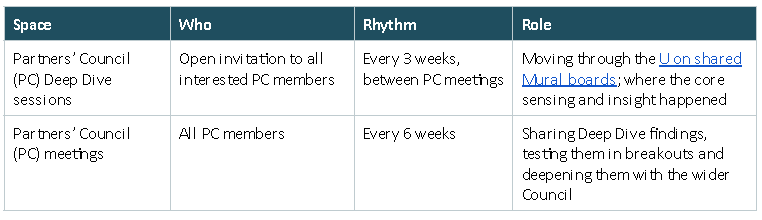
Bounce Beyond’s role. As a member of the co-design team, Bounce Beyond introduced the U as the architecture of the journey, facilitated the Deep Dives and Council sessions, and synthesized each board into summaries and “deeper insights” that fed the next step.
Where it sits in the bigger design. This is Phase 1 (Initiating, April–September 2026) of NEF’s four-phase design. Phase 2 (Topic Development, October 2026–March 2027) adds deeper collaborative work, Phase 3 is the Cairo convening, and Phase 4 is pathway redesign from April 2027.
The journey

Steps 1–4 follow the U from letting go to letting come; steps 5–6 carry the insight into testing and action.
1. Checking in: what is this work truly in service of?
The journey began by grounding the Council in purpose before planning. Partners explored what the work serves and the deeper intent behind Cairo, held alongside the NEF27 Vision and Purpose: an economy whose purpose is the well-being of people and planet, ecologically and socially just.
What the work serves: coherence, collaboration and collective action across the wider movements; pathways toward systemic change and post-capitalist futures; Global South perspectives and community-led change; and economic transformation grounded in compassion, ecology and relationship.
The deeper intent for NEF: a shared direction, and clearer pathways; stronger trust across diverse movements; connecting local experiments into a broad global movement; and a shift from ego-system to ecosystem thinking.
Takeaway: Next Economies Forum is in service of the field, not of any single organisation. Its success is measured by coherence and relationship.
2. Co-sensing: entering the field
Partners moved from assumptions toward a shared understanding of reality, mapping the scope of NEF, the pathway to Cairo, what is known and unknown, and the resources at hand.
- Scope: regenerative, solidarity and community-owned economies; place-based solutions linked to global learning; key geographies in Africa, Latin America, South-East Asia, North Africa and small island states; themes of decolonisation, justice and wellbeing; Indigenous, feminist and more-than-human perspectives.
- The journey: a wish for possibilities around the “Cairo journey”; pre-event workshops, study groups and thematic labs; interest in imagination labs, language justice and relational field-building; a move from knowledge toward wisdom.
- Known and unknown: funding is the major shared constraint; the field is seen as fragmented and siloed; small grassroots actors are undervalued yet vital; bureaucracy, ego and competing priorities limit collaboration.
- Resources that exist: partner networks, engaged foundations, large pools of philanthropic capital yet to be activated, and people power across youth, volunteers and communicators.
- Resources to develop: mindset-shift programmes, co-designed shared narratives, a live ecosystem map and matchmaking site, incubators for alternative movements, collaboration awards, and an open letter toward an ethical world trade framework.
Takeaway: the field has substance, diversity, reach and shared narratives. What it lacks is connective tissue, visibility and more coherence.
3. Presencing: what is inhibiting movement emergence?
At the bottom of the U, partners looked at the mental models, invisible barriers, ego and fear beneath the surface, and at what becomes possible when we loosen our grip on the old.
- What inhibits emergence: growth ideology and GDP-as-wellbeing; legal frameworks that reward extraction; weak mutual trust between organisations; short-term, metrics-driven planning; Western individualism and colonial patterns in funding and governance; burnout, grief and survival mode; scarcity and competition for limited resources.
- What becomes possible: a shift from control to connection; new forms of trust and collective imagination; deeper connection with living systems; interdependence becoming more visible than accumulation; transforming grief into collective responsibility; marginalised voices gaining room; and one larger movement able to coalesce.
Takeaway: the barriers are as much inner and relational as they are structural. Transformation starts with how the movement relates to itself and continues with building distributed power.
4. Co-creating: letting go and letting come
Partners asked what NEF must let go of, what patterns Cairo must refuse to reproduce, what is waiting to emerge, what unique experience Cairo must offer, and which design principles must guide it.
Letting go: five patterns Cairo must not repeat
- Identity over stewardship: institutional attachment, ego, “we know best” and expert culture.
- Control over emergence: certainty, perfectionism and over-analysis.
- Competition over contribution: zero-sum funding and self-preservation.
- Separation over relationship: silos, hidden othering and performative collaboration.
- Fear over courage: fear of failure and reluctance to let go.
Waiting to emerge: a true co-creation culture; explicit conversations about viable alternatives; space for emergence over tight control; fear reframed as a companion; and fluid identities rather than fixed representation.
Letting come:
- Relational connection.
- Co-creating action.
- Humility and roots.
- The invisible power held by millions.
The unique experience and five design principles for Cairo
- Grounding in trust and relational space, making the most of in-person presence.
- Generative diversity: marginalised, rural, Indigenous and Egyptian voices, funded access for the Global South.
- Co-creation, agency and shared ownership, with partners as co-proposers and co-creators.
- Flexible, high-energy formats: festival-style and open spaces, and respect for the local context and ancient wisdom of the land.
- Clear orientation and process alignment: showing where we are on the journey, clear roles, and a closing “Ask” that invites commitment.
Methods named include poster sessions, app-based matchmaking, open themed corners, embedded task forces and hubs, and explicit processes for navigating the dismantling of extractive systems.
Takeaway: The challenge is no longer imagining next economies. It is becoming the kind of broad movement or field capable of bringing the economies of future into being.
5. Survey: testing emerging themes and design implications
The insights from the U were translated into a survey so the wider Council could weigh in on the emerging themes and what they mean for the Forum’s design.
Priority Themes
- Movement Coherence
Diverse initiatives already know how to cooperate; the call here is for practical experiences of collaboration, and getting to know each other deeply, and working together.
- Holistic Consciousness, Inner Unfolding, Learning & Narrative Change
Next economies require shifting consciousness, values, and mental models, not just strategy. This stream covers the “how”: narratives, learning, education, capacities, and faith, spirituality, ethics, and inner transformation.
- Power, Policy, Governance & Systemic Transition
Exploring new configurations for direction-setting, decision-making, and action at the group, organizational, network, or planetary level.
- Pluriversal Economies & Majority World Perspectives
Structurally centering Global South/Majority voices and approaches, not as an add-on. Includes local currencies, community-centered economic models, and examples of Global South innovation.
- Steward Ownership, New Enterprises & Transition Financing
Ownership forms, business models, and financing tools that support a socially and ecologically just economy.
Design Principles
Interactive – including as many participants as possible
Emergent – supporting new collaborations and actions
Co-creative – engaging others in designing/describing new possibilities
Action methods – have people move around
Body awareness – raising awareness of the physical body and its direct, sensory experiences
Relational – create opportunities for people to connect to each other, generate mutual value
Inclusive – be supportive of cultural and linguistic differences
6. Moving forward: forming activity on the online platform
The journey is now moving up the right side of the U, from crystallising toward prototyping. Partners are gathering on Hylo, a shared online platform around the emerging themes and an emerging design ecology for the Next Economies Forum, turning intention into self-organised activity.